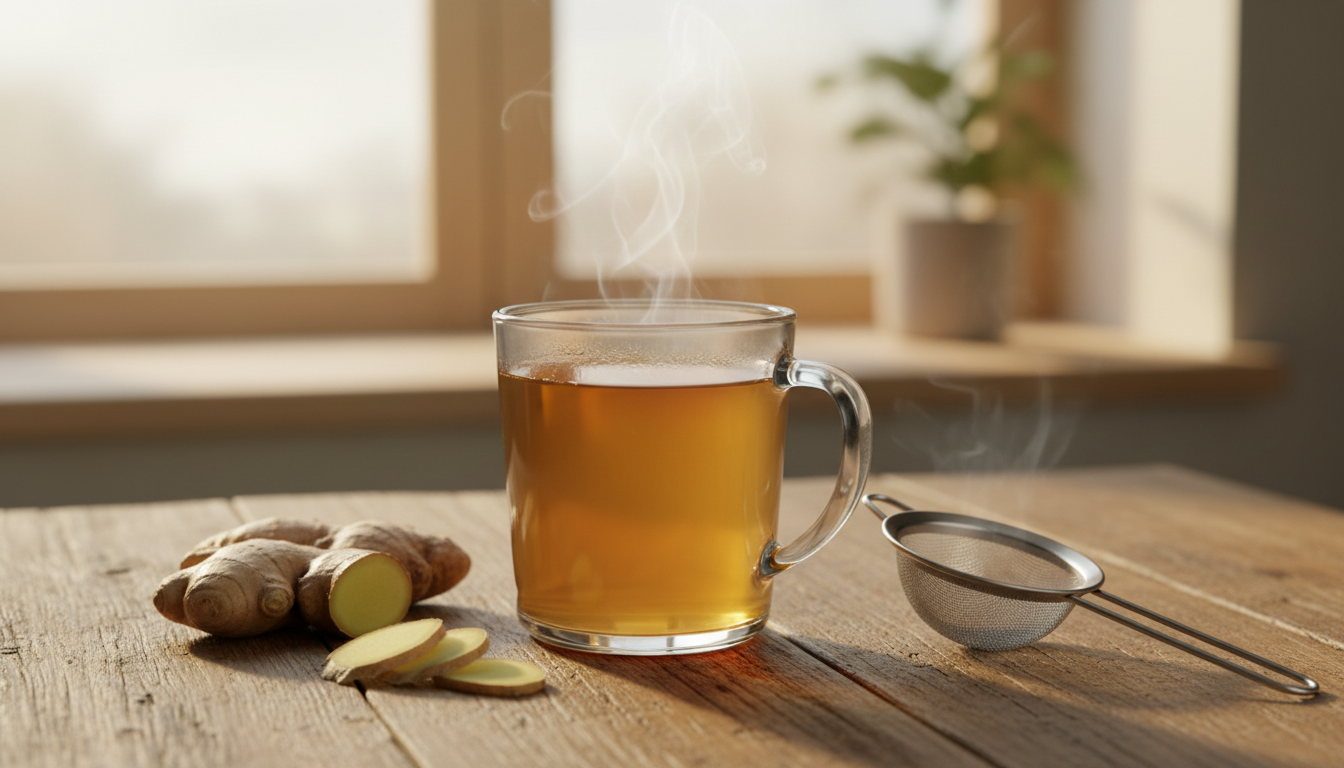
Ginger tea is a warm drink made by steeping or simmering fresh ginger root in water. It may ease mild nausea, and it is a pleasant, caffeine-free way to drink more fluids, but it is not a cure for any disease. Most of the research tested ginger capsules, not cups of tea, so the honest answer is “helpful for some people, for some problems, in modest ways.” Here is what the evidence says, how to make a cup that tastes like ginger, and who should be careful.
What is ginger tea?
Ginger tea is an infusion of ginger root (Zingiber officinale), which is the underground stem of the plant. You can make it from fresh slices, grated root, dry ginger powder (sonth) or a tea bag. Plain ginger tea has no tea leaves in it, so it has no caffeine. In India most people know it as adrak chai, which is usually black tea boiled with ginger, milk and sugar. That version does contain caffeine from the tea leaves.
This difference matters. Adrak chai and plain ginger water have different caffeine, sugar and calories. Many articles mix them together, so we keep them apart below.
What does the research say about ginger tea benefits?
The US National Center for Complementary and Integrative Health (NCCIH) says many studies of ginger exist, but some were not high quality, and most nausea studies tested dietary supplements rather than foods (NCCIH page last updated February 2025). That one line should shape how you read every claim. A study of capsules does not prove that one cup of tea does the same thing.
Here is how the main claims stack up, using the NCCIH ginger fact sheet as the anchor:
| Claim | What the evidence says | How much to trust it |
|---|---|---|
| Nausea in pregnancy | NCCIH says research shows ginger may help. The NHS says there is some evidence ginger may reduce nausea and vomiting. | Moderate. Best supported use. |
| Motion sickness | NCCIH says most studies have not shown it to be helpful. | Weak. Do not rely on it for a long bus ride. |
| Nausea after chemotherapy or surgery | NCCIH says it is uncertain whether ginger adds anything to standard treatment. | Unclear. Ask your oncology or surgical team. |
| Period cramps | NCCIH says ginger supplements might reduce the severity of menstrual cramps. | Possible. Studies used supplements. |
| Knee osteoarthritis | NCCIH says supplements might help, but much of the research was poor quality. | Weak to moderate. |
| Weight loss, cancer, brain health | Mostly animal or test tube studies, or small trials. | Too early to say. Treat as unproven. |
Notice what is missing: no strong proof for colds, weight loss or “detox.” Websites often list these as benefits. The honest status is “traditional use, limited human evidence.”
Does ginger tea help with nausea?
Yes, it may, and this is the strongest reason to try it. The NHS guidance on morning sickness says to eat or drink foods containing ginger, and that there is some evidence ginger may reduce nausea and vomiting. It also says to check with a pharmacist before taking ginger supplements in pregnancy (NHS page, checked October 2026).
Ginger is not a fix for severe vomiting. The NHS says to contact a midwife, GP or 111 without delay if you cannot keep food or fluids down for 24 hours, have very dark urine, or feel faint. Tea suits mild queasiness only.
Motion sickness is a different story. Some websites say the tea calms it, but NCCIH says most studies have not found ginger helpful. If trips make you sick, ask a pharmacist about proven options and treat the tea as a comfort drink.
How much ginger tea is safe to drink in a day?
No official cup limit exists. Healthline reports that the US FDA lists ginger as generally recognised as safe and that up to 4 grams of ginger a day is considered safe (article updated September 2026). A cup made from a few thin slices holds far less, so one to three cups a day is a sensible range for most healthy adults. This is a practical estimate, not a medical rule.
NCCIH lists the usual side effects of oral ginger: abdominal discomfort, heartburn, diarrhea, and mouth or throat irritation. If a strong cup gives you heartburn, make it weaker or drink it after food.
Who should be careful with ginger tea?
- People who take any regular medicine. NCCIH says to talk with your health care provider before using ginger, because some herbs and medicines interact in harmful ways. Blood thinners and blood pressure tablets are the usual worry.
- Pregnant women. Small amounts in food and drink are widely used for nausea, but check with your doctor or midwife before using ginger supplements or drinking large amounts.
- Breastfeeding mothers. NCCIH says little is known about safety while breastfeeding.
- People with acid reflux or ulcers. Ginger can cause heartburn in some people.
- Anyone about to have surgery. Tell your surgeon about regular ginger use, since some reports link ginger to effects on blood clotting. The research here is still limited.
How to make ginger tea at home
Popular recipes tell you to simmer ginger anywhere from 4 to 45 minutes. That is a big range, so I lined four of them up. This is a reading of the recipes, not a lab test.
| Source (accessed October 2026) | Ginger used | Simmer time | Result |
|---|---|---|---|
| Blinkit recipe | 1 inch, grated, in 2 cups water | 5 to 10 minutes | Light and quick |
| Dassana’s Veg Recipes (adrak chai) | 2 inches, crushed, in 4 cups water | 4 to 5 minutes before tea is added | Spiced milk tea |
| Healthline | 4 to 6 thin slices in 2 cups water | 10 to 20 minutes | Stronger, spicier |
| A Pretty Life in the Suburbs | 1 large root in 5 cups water | 20 to 45 minutes | Very strong, needs dilution |
The pattern is simple. Crushed or grated ginger releases flavour fast, so it needs less time. Thin slices need longer. Longer simmering gives a sharper cup. If you are new to ginger, start with the shortest time and add minutes until it suits you.
Basic recipe (makes 2 cups)
- Wash a 1 inch piece of ginger. Peeling is optional. Crush it with a mortar or the back of a knife, or slice it thin.
- Add it to 2 cups of water in a small pan and bring to a boil.
- Lower the heat and simmer 5 to 10 minutes for a mild cup, or up to 20 minutes for a strong one.
- Strain into cups. Add lemon juice or a little honey if you like.
Adrak chai. Follow the same steps, then add 3 to 4 teaspoons of black tea and simmer a minute or two. Add milk and simmer again briefly. The recipe from Dassana’s Veg Recipes uses 8 teaspoons of sugar for 4 cups, and its own nutrition panel lists about 49 kcal and 9 g of sugar per cup. That is about 2 teaspoons of sugar a cup. If you drink three cups a day, the sugar adds up faster than the ginger helps. Cutting the sugar in half is an easy win.
Which type of ginger tea should you choose?
Here is a simple way to decide. It is my own framework based on the evidence above, not a clinical guideline.
- For mild nausea: fresh ginger, weak to medium, sipped slowly. No tea leaves, no sugar load.
- For a morning ritual: adrak chai, with less sugar. Remember it contains caffeine.
- For evenings: plain ginger water. It has no caffeine.
- For convenience: tea bags. Read the label, because many bags hold very little ginger. Our look at Twinings Lemon and Ginger tea shows what to check.
- For medicinal doses: do not rely on tea. Talk to a doctor before taking ginger capsules.
Common mistakes with ginger tea
- Expecting one cup to work like the capsules used in studies.
- Boiling for 45 minutes and then wondering why it burns your throat.
- Adding so much sugar that a “healthy” drink becomes a sweet one.
- Using it as the only remedy for vomiting that will not stop.
- Forgetting that ginger milk tea still has caffeine.
Does ginger tea break a fast?
Plain ginger water with no sugar, honey or milk adds almost no calories, and our guide on whether herbal tea breaks a fast covers how different teas behave. Adrak chai with milk and sugar does add calories, so it would break most fasts.
Frequently asked questions
Is it safe to drink every day? For most healthy adults, one to three cups a day appears reasonable. Check with a doctor first if you take medicines or have a health condition.
Can I drink it at night? Plain ginger water has no caffeine. Adrak chai does, so skip it close to bedtime.
Fresh ginger or powder? Fresh gives a brighter flavour. Dry ginger powder works, but use a small pinch because it is much stronger.
Can it cure a cold? No. A warm drink can soothe a sore throat and keep you hydrated, but strong proof that ginger treats colds is missing.
The bottom line
It is a safe and tasty habit for most people, with the best evidence in mild nausea, including pregnancy nausea. Keep expectations modest, watch the sugar, and speak to your doctor if you use blood thinners or other medicines. If you like exploring herbal drinks, see our guides to moringa tea benefits and the healthiest herbal teas, or read about herbal tea in India.
This article is for general information and is not medical advice. Research date: 21 October 2026.

Leave a Reply