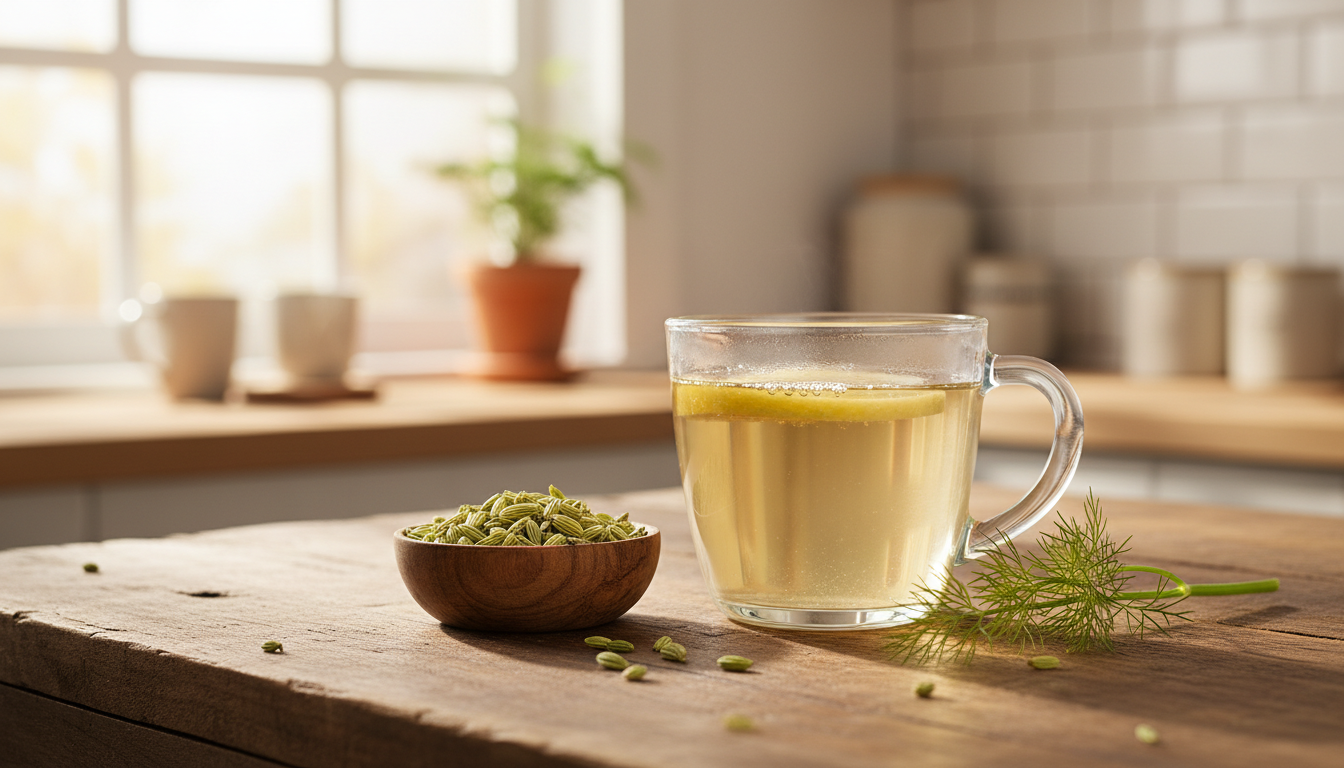
Fennel tea is a caffeine free drink made by steeping fennel seeds, called saunf in India, in hot water. Its best supported use is easing mild bloating, gas and stomach cramps after a meal, and that support comes mostly from long traditional use, not from strong trials. Studies on period pain look promising but are low quality. A sensible adult serving is about 1.5 grams of seeds in a cup of boiling water, steeped for 15 minutes, up to three cups a day, for no more than two weeks at a time. Skip it or ask a doctor first if you are pregnant, breastfeeding, allergic to celery or mugwort, or giving it to a child under four.
What is fennel tea?
Fennel tea is an infusion of the dried seeds of Foeniculum vulgare, a plant in the carrot family. The seeds are botanically the plant’s fruit, which is why European regulators call them “fennel fruit.” The tea tastes lightly sweet, a bit like licorice, because the seeds contain a compound called anethole.
Do not confuse it with the saunf you chew after a restaurant meal. That mukhwas is often coated with sugar or colour. Plain fennel seeds in water are a simpler, sugar free choice.
Does fennel tea work? What the evidence says
Here is how the common claims hold up. “Traditional use” means a regulator accepts the herb because people have used it safely for decades, not because trials proved it works.
| Claim | What the evidence shows | Strength |
|---|---|---|
| Mild gas, bloating and spasm | The European Medicines Agency (EMA) lists fennel as a traditional herbal remedy for mild, spasmodic stomach complaints including bloating and flatulence. | Traditional use |
| Period cramps | A 2020 review of 12 trials found fennel about as effective as common painkillers such as mefenamic acid. The trials were all from Iran, and most used fennel oil, not tea. | Low certainty |
| More breast milk | A review in the US LactMed database says two small studies saw some rise in milk volume, but no valid conclusion could be drawn. | Weak |
| Weight loss or detox | I found no solid human trials in the sources reviewed for this article. | Not supported |
Let me explain the period pain row, because it is the most quoted. The 2020 meta-analysis in Nutrients pooled 12 randomised trials. Against painkillers, fennel scored about the same, with no meaningful difference between them. Against placebo, fennel looked better, but the results varied hugely from study to study (heterogeneity of 98 percent). The authors rated the certainty of the evidence as low and noted that only three trials checked side effects. You can read the full fennel and primary dysmenorrhea meta-analysis yourself.
So it may help some people, but nobody can promise it will. If you have severe or new pain, a doctor visit matters more than any tea.
What other fennel tea pages leave out
I read the top articles for this keyword in India before writing this one. Most give a recipe and a list of benefits. Few give a seed amount, a steeping time, a daily limit or a safety section.
- One Ayurveda page says the tea increases fat burning and helps irritable bowel syndrome, with no sources.
- A shop blog describes “detox” and “cooling” effects but gives no seed quantity at all.
- Recipe pages say to simmer or steep for “a few minutes,” while the EMA monograph uses 15 minutes.
- None of the pages I read mention the EMA’s two week limit or its advice on pregnancy.
That gap is the reason for the dose guide and safety sections below.
How to make fennel tea
This method follows the EMA’s tea dose for adults and adolescents, converted into kitchen measures. Use a kitchen scale if you have one, because a teaspoon of seeds varies with seed size.
- Measure 1.5 grams of fennel seeds. That is roughly three quarters of a teaspoon.
- Crush them lightly with the back of a spoon. Crushing breaks the seed coat so more flavour reaches the water.
- Boil 250 ml of water (one large cup) and pour it over the seeds.
- Cover the cup with a saucer and steep for 15 minutes.
- Strain and drink warm. Honey is optional, but never give honey to a child under one year.
Want a stronger taste? Add more seeds rather than steeping for an hour. I found no research showing that longer steeping is safer or better.
To vary the flavour, add a thin slice of ginger (see our guide to ginger tea) or a few mint leaves. Our post on peppermint tea for gas covers the evidence for mint.
How much fennel tea can you drink?
The EMA monograph, last revised on 31 January 2024, gives adults and adolescents one 250 ml cup three times a day, which is 4.5 grams of seeds daily. It also says not to use it for more than two weeks. For children aged 4 to 12, it lists a smaller dose of 1 gram in 100 ml, three times a day, for less than a week. You can read the exact wording in the EMA fennel fruit monograph.
These numbers describe medicinal use for symptoms. If you only enjoy a cup now and then after dinner, you are well inside them. If you drink fennel tea from a flask all day, every day, you are going beyond what the regulators have reviewed.
Who should avoid fennel tea?
This section matters more than the recipe. Fennel is generally well tolerated by healthy adults, but these groups should be careful.
- Pregnant and breastfeeding women. The EMA says safety has not been established and use is not recommended without enough data. It also notes that anethole passes into breast milk. LactMed describes two newborns, aged 15 and 20 days, who became lethargic and fed poorly after their mothers drank over 2 litres a day of a fennel and anise tea. The babies improved within 24 to 36 hours after the tea and breastfeeding stopped. Ask your doctor before using it.
- Babies and young children. The EMA does not recommend fennel tea under age 4. This includes the popular home remedy of fennel water for infant colic. Talk to a paediatrician first.
- People with allergies. Fennel belongs to the same family as celery, carrot, coriander, dill, caraway and aniseed. The EMA lists allergy to these, or to mugwort pollen, as a reason not to use it.
- People on regular medicines. I did not find reliable interaction data for fennel tea. If you take hormone treatment or have a hormone sensitive condition, ask your pharmacist.
There is one more point about estragole, a natural compound in fennel. High doses caused tumours in rats. The EMA concluded in 2005 that short term adult use at recommended doses does not pose a significant cancer risk. Its 2023 statement adds that estragole intake should be as low as practically achievable, and kept low in young children and in pregnant and breastfeeding women. That is a good reason to stick to the dose above.
Common fennel tea mistakes
- Treating it as a weight loss or detox drink. The evidence does not support that.
- Drinking it daily for months. The monograph’s limit is two weeks for symptom relief.
- Giving it to infants because “it is natural.” Natural does not mean tested for babies.
- Ignoring symptoms that do not go away. Gas, pain or bloating lasting more than a couple of weeks needs a check-up.
- Assuming a flavoured tea bag has the same amount of fennel. Blends such as mint and fennel or cumin, coriander and fennel (CCF) contain less per cup, so read the label.
Fennel tea compared with other herbal teas
If you want a caffeine free drink after meals, this is one option. Hibiscus is another, though its tartness and blood pressure effects are very different, as covered in our hibiscus tea benefits guide. Plain herbal tea also does not usually break a fast, but the details depend on the tea and the reason for fasting, which we cover in this tea by tea answer. For how herbal teas count toward your daily fluids, see is herbal tea the same as water.
My opinion, not a research finding: it suits people who like its taste and want a calm, sugar free habit after a heavy meal. It is not a medicine, and no tea replaces a doctor for ongoing symptoms.
Fennel tea FAQ
Is it good for gas? It may help mild gas and bloating. The EMA accepts it for that use based on tradition, but I did not find large modern trials of the tea itself.
Does it have caffeine? No. Fennel seeds contain no caffeine, so it is fine in the evening unless a blend includes tea leaves.
Can I drink it every day? A short course of up to two weeks is the reviewed limit. After that, take a break and see a doctor if symptoms continue.
Does it help weight loss? There is no good evidence that it does. Swapping a sugary drink for it may help, but that comes from the sugar you skip.
Does it increase breast milk? The evidence is weak and the safety data for nursing mothers is limited. Speak to a lactation consultant or doctor first.
The bottom line
Fennel tea is a gentle, caffeine free drink with a long history for mild stomach discomfort. Brew about 1.5 grams per cup for 15 minutes, keep to three cups a day, and stop after two weeks. Avoid it in pregnancy, breastfeeding and early childhood unless a doctor says otherwise. This article is for general information and is not medical advice.



Leave a Reply