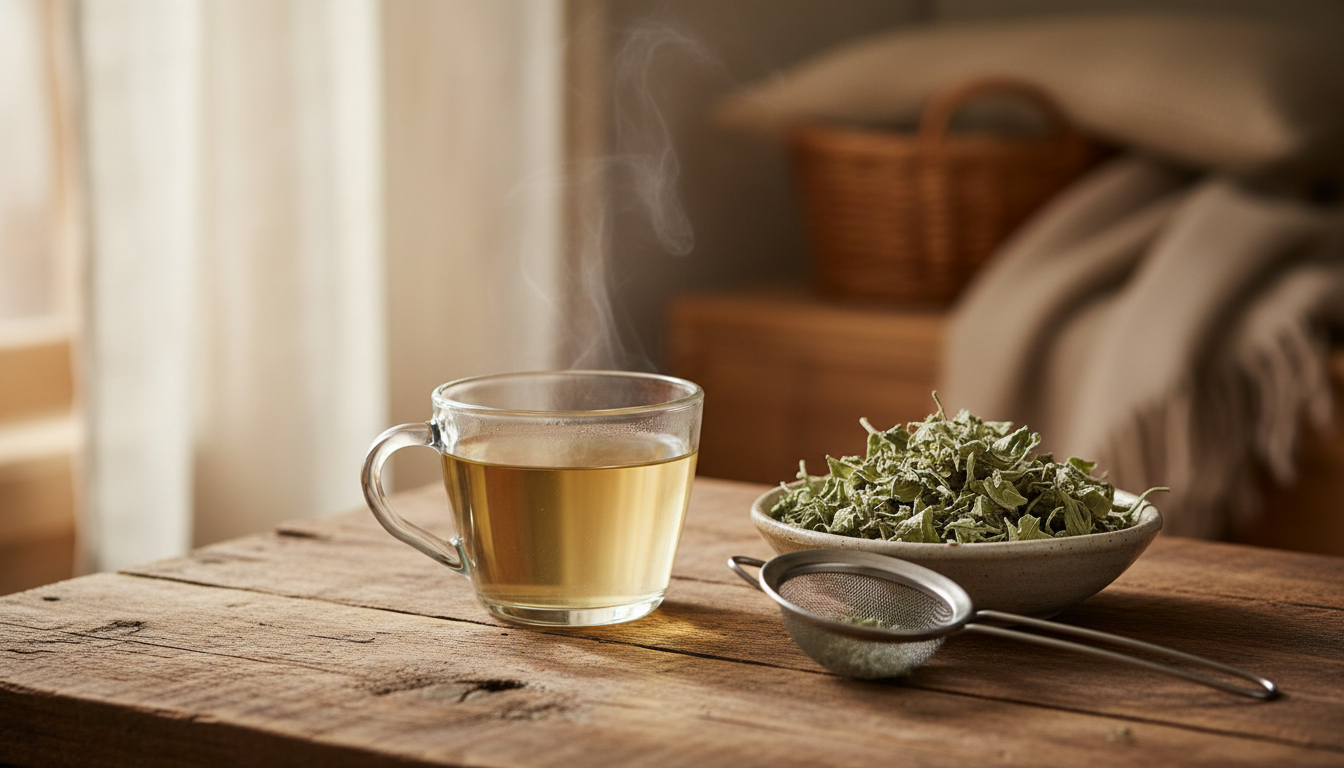
Mullein tea is a caffeine-free herbal drink made from the leaves or flowers of the mullein plant (Verbascum thapsus). People drink it mostly for coughs and chest congestion, but the evidence is thin. Most studies used lab extracts, and none of the sources I read describes a good human trial of the tea itself. A strained cup is unlikely to harm most healthy adults, yet it is not a medicine. This guide covers what research shows, how to brew it, and who should skip it.
What is mullein tea?
It is an herbal infusion, also called a tisane. You make it by steeping dried or fresh mullein leaves or flowers in hot water. The mullein plant is not the tea plant (Camellia sinensis), so the cup holds no true tea leaves and no caffeine.
Common mullein is a biennial, which means it lives for two growing seasons. In year one it forms a low rosette of large, fuzzy leaves. In year two it sends up a tall stalk with small yellow flowers (WebMD, reviewed January 2025). A 2022 review in Phytotherapy Research describes it as native to parts of Europe, Africa and Asia.
Does mullein tea help with cough and lungs?
It might soothe, but it is not proven. People have used mullein for generations for hoarseness, colds, cough, asthma and bronchitis. A 2021 review of Spanish folk medicine found that the most common way to use it for these problems is to take infusions, macerations or syrups, alone or mixed with other plants (Blanco-Salas and colleagues, Biology, 2021).
That is history, not proof. The same review worked from published literature and computer simulations, not from a trial in patients. Medical News Today (reviewed July 2025) notes that most research tests parts of mullein in test tubes, and that it is unclear how much of the plant’s active compounds reach a brewed cup.
WebMD calls mullein an expectorant, meaning it may help you cough up mucus, and a demulcent, meaning it may coat and soothe irritated tissue. It also says there has been very little study in a medical setting. The NHS says something similar about coughs in general: there is limited evidence that hot lemon and honey or herbal medicines ease a cough.
Mullein tea benefits: claim by claim
Websites list many benefits. This table sorts them by what was studied and how strong the link is to a cup of mullein tea.
| Claim | What was actually studied | Strength for a cup of tea |
|---|---|---|
| Eases cough and loosens mucus | Traditional use, literature reviews, lab work | Weak. No human trial of the tea found in the sources I read |
| Fights viruses | Test tube extracts against influenza and a herpes family virus | Very weak. Not shown in people |
| Fights bacteria | Older lab work was positive, a 2025 study of water infusions found no effect on E. coli or S. aureus | Weak and conflicting |
| Antioxidant effect | Mullein contains flavonoids, but in the 2025 infusion study it ranked among the lowest of five herbs | Weak |
| Heals wounds | A cream, tested in 93 first time mothers after an episiotomy cut | Not about tea |
| Helps sleep, joints or immunity | Claimed on some sites, with no human trial of tea cited in the articles I read | Unproven |
In the wound healing trial, women applied mullein cream or a placebo cream twice a day for 10 days, and the mullein group healed better (BMC Complementary Medicine and Therapies, 2021). A cream is not a cup of tea, so it says little about drinking it.
What did the 2025 study of mullein infusions find?
Many mullein studies use concentrated extracts or single plant compounds. A 2025 study in Applied Sciences (Bilušić and colleagues, published 17 March 2025) tested plain water infusions, which are closer to what you drink. It compared mullein with four other herbs.
The mullein infusion showed no antibacterial activity against E. coli or Staphylococcus aureus at any concentration tested. It also ranked among the lowest of the five herbs for antioxidant activity. An older 2015 test tube study cited by Healthline did find some bacterial growth reduction, so the evidence conflicts.
That does not prove the tea is useless, since it tested two bacteria in a lab dish. It does show why claims built on strong extracts should not be copied over to a home cup.
How to make mullein tea
Published instructions vary a lot. Here is how four of the top results tell you to brew it.
| Source | Dried leaf | Water | Steep time |
|---|---|---|---|
| PharmEasy (updated Sept 2026) | 1 teaspoon | 1 cup hot water | 5 to 10 minutes |
| WebMD (Jan 2025) | 1 to 2 teaspoons | 1 cup | 10 to 15 minutes |
| Healthline (May 2025) | 1 to 2 tablespoons | 8 oz (240 ml) boiling | 15 to 30 minutes |
| Medical News Today (July 2025) | A handful of foraged dried leaves | About 8 oz boiling | 30 minutes or more |
The leaf amount differs by up to six times (1 teaspoon against 2 tablespoons), and so does the steep time. None of these methods was tested in a clinical trial. Here is a middle path built from where the ranges overlap. It is my suggestion, not a tested dose.
- Put 1 to 2 teaspoons of dried mullein leaf in a cup or infuser.
- Pour about 240 ml (1 cup) of just boiled water over it and cover the cup.
- Steep for 10 to 15 minutes.
- Strain through a coffee filter or several layers of cheesecloth. WebMD and Healthline both say this removes the tiny leaf hairs that can irritate the throat.
- Add lemon or honey if you like. Do not give honey to babies under 1 year (NHS).
WebMD describes the taste as slightly bitter and earthy to some people, and mildly sweet and a little like peppermint to others. Fresh or dried leaves both work.
No trial has set a daily amount. PharmEasy suggests 2 to 3 cups a day and WebMD says three or four times a day, but neither cites a dosing study. Starting with one cup and watching how your throat and skin react is a reasonable approach.
Is mullein tea safe? Who should skip it
Most sources describe few known side effects. MedicineNet notes no reports of toxicity, and WebMD says there are not many known side effects or drug interactions. “Few known” is not the same as proven safe, though. Skip it, or ask a doctor first, if any of these fit you:
- You are pregnant or breastfeeding. All five articles I read say safety has not been established.
- You have asthma or COPD. Do not swap a prescribed inhaler for tea. Healthline warns that asthma can quickly become life threatening, so mullein tea should never replace your treatment plan.
- You take regular medicines. MedicineNet says herbs can interact with medication, while PharmEasy says none have been reported. Ask your doctor or pharmacist.
- You react to plants. Mullein can rarely cause contact dermatitis. A 2019 case report described a 12 year old with a reaction after exposure to V. thapsus and plants from the daisy family, and the researchers could not rule mullein out. Stop if you get a rash, itching or swelling.
Two more rules. Always strain the tea well. And never use it as an enema. MedicineNet calls this unsafe, because enemas done wrongly can injure tissue and upset your body’s salts.
For a wider look at herbal tea risks, see our guide to tea side effects.
When a cough needs a doctor, not a tea
The NHS advises seeing a GP if a cough lasts more than 3 weeks, if you lose weight for no reason, or if your immune system is weak. Get urgent help if your cough is very bad or quickly gets worse, you feel very unwell, you have chest pain, you find it hard to breathe, or you cough up blood. A tea should never delay that.
Buying mullein tea in India: what to check
Mullein leaf and mullein tea bags are sold online and in herbal shops. A few simple checks help:
- Look for the Latin name Verbascum thapsus on the label, since “mullein” can cover many related plants (PharmEasy).
- Check the expiry date and the ingredient list. Store the leaves in a sealed jar away from light, heat and moisture.
- Skip big promises on the pack, and do not forage wild plants unless you can identify them with certainty.
For background, see our piece on herbal tea in India.
How mullein tea compares with other herbal teas
If a warm herbal drink is what you want, other teas have clearer track records for specific problems. Our ginger tea guide covers a recipe and who should skip it, and our article on peppermint tea for gas explains what works for bloating. For a broader view, read the healthiest herbal teas.
Mullein tea questions
Is mullein tea caffeine free?
Yes. It comes from the mullein plant, not the tea plant, so sources describe it as caffeine free.
Does mullein tea clean the lungs?
No evidence shows that it cleans or detoxes lungs. WebMD says mullein can loosen phlegm so it is easier to cough up. That is not the same as cleansing.
The bottom line on mullein tea
Mullein tea is a mild, caffeine-free herbal drink with a long history for coughs. Modern evidence is mostly from test tubes and extracts, one 2025 study of water infusions found no antibacterial effect, and no source I read shows a human trial of the tea itself. Enjoy it for the warmth and taste if you want to, strain it well, skip it in pregnancy, and see a doctor for a cough that lasts over 3 weeks. This article is for information only and does not replace medical advice.



Leave a Reply