
Nettle tea is a caffeine free herbal drink made by steeping the leaves of the stinging nettle plant (Urtica dioica). It tastes mild and a little like spinach. Small trials of nettle extracts hint at help for blood sugar and prostate symptoms, but most of those trials used capsules, not tea, so a cup is not a proven treatment. For most healthy adults, one or two cups a day is a reasonable thing to try. If you are pregnant, or you take medicine for diabetes, blood pressure or blood thinning, talk to your doctor first.
What is nettle tea?
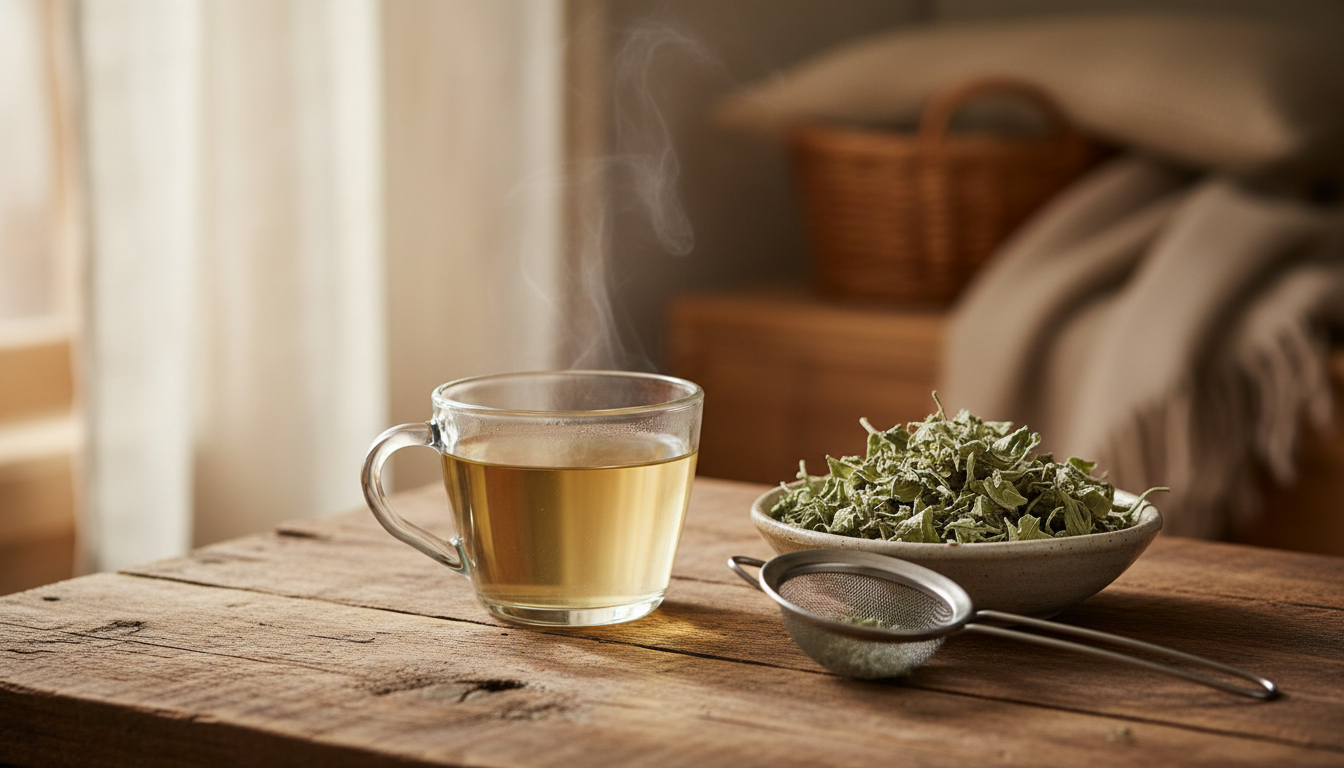
Nettle tea is an infusion. You pour hot water over dried or fresh nettle leaves and let them steep, the same way you would make mint or tulsi tea. It is not made from the tea plant (Camellia sinensis), so it has no caffeine.
Raw nettle leaves sting because of tiny hairs that carry irritating chemicals, including formic acid. A 2018 review in the journal Molecules (Kregiel and colleagues) notes that hot water infusion, drying or cooking makes nettles safe to eat, which is why a properly brewed cup does not sting.
In India you may see it sold as Himalayan nettle tea, and the plant is often called bichhu booti in Hindi. The leaves are rich in minerals and vitamins. BBC Good Food lists 90 g of blanched nettles as having about 428 mg calcium and 444 mcg vitamin K. That is for cooked leaves. A cup of tea pulls out far less.
What does the evidence say about nettle tea?
Nettle has been studied for years, but good human trials are few, small and mostly use concentrated extracts. Many articles skip that detail.
Does nettle tea lower blood sugar?
This is the best studied claim. In a 2013 double blind trial, Kianbakht and colleagues gave 92 people with advanced type 2 diabetes either a nettle leaf extract capsule (500 mg every 8 hours) or a placebo for three months. All of them needed insulin therapy. The nettle group had significantly lower fasting glucose and HbA1c than the placebo group. You can read the abstract in the published nettle diabetes trial on PubMed.
Two cautions. It was one trial, and it used an extract, not tea. Nobody knows if a cup of nettle tea gives a similar dose. Also, Memorial Sloan Kettering Cancer Center lists a case of low blood sugar in a 78 year old man who took an herbal product containing nettle. If you use diabetes medicine, it could in theory push your sugar lower.
Does nettle help with prostate symptoms?
Nettle root is the part usually linked to benign prostatic hyperplasia (BPH), an enlarged prostate. A 2013 Iranian trial (Ghorbanibirgani and colleagues) gave 100 men with BPH either nettle capsules (300 mg, two capsules twice a day) or a placebo for eight weeks. The nettle group reported a big fall in symptom scores, while the placebo group did not change.
The size of that change is unusually large, and later reviews describe mixed results across studies, with some positive studies using herb blends. Treat it as a hint, not proof. If you have trouble passing urine, see a doctor. Do not rely on a tea.
Can nettle help with allergies and hay fever?
A 2016 review by Baumgardner reports that in one small study, 57% of people rated nettle as effective for allergies and 48% said it beat their earlier allergy medicine. Those are self ratings, and they do not prove nettle works better than a dummy pill. There is also a reverse risk: MSK records allergic rhinitis in two people after exposure to nettle pollen.
What about joint pain, blood pressure and cancer?
One small trial of 37 people with acute arthritis found that 50 g of stewed nettle leaves a day plus 50 mg of diclofenac worked about as well as the full 200 mg dose of diclofenac over two weeks (as summarised in the Kregiel review). That used a large amount of cooked leaf plus a drug. It says little about tea.
For blood pressure, cholesterol and cancer, the support is mostly from animal and test tube studies. Some websites say a daily cup lowers blood pressure. The evidence in people is not strong enough to say that.
Trial doses versus a cup of nettle tea
This comparison is the part most guides leave out. The studies above and a normal cup are not the same thing.
| What was tested | Form and amount | Can a cup match it? |
|---|---|---|
| Type 2 diabetes (2013) | Leaf extract, 500 mg every 8 hours, 3 months | Unknown. Tea is a weak extract. |
| BPH (2013) | Capsules, 600 mg twice a day, 8 weeks | Unknown. Different form. |
| Acute arthritis | 50 g stewed leaves daily plus diclofenac | No. A cup uses a few grams of leaf. |
| Everyday cup | About 2 tsp dried leaf, steeped in a mug | Fine for flavour and fluids |
So the fair way to see it is as a pleasant, mineral rich herbal drink that may help a little, and not as a substitute for medicine.
How to make nettle tea
Sources disagree on steep time. Wolf Camp suggests about 5 minutes covered, Het Kleinste Huis says 5 minutes, and BBC Good Food says 10 to 15 minutes for dried leaves. A simple approach: start at 5 minutes, then steep longer if you want a stronger, greener taste.
With dried leaves
- Put about 2 teaspoons of dried nettle leaves in a mug or teapot.
- Pour over a cup of freshly boiled water.
- Cover with a lid or plate so the aroma stays in the cup.
- Steep for 5 to 10 minutes, then strain.
- Add lemon or a little honey if you like.
With fresh leaves
Wear gloves, because the raw leaves sting. Use about 1 cup of rinsed leaves for 2 cups of water. Bring them to a boil, switch off the heat and let them sit for about 5 minutes, then strain. BBC Good Food advises picking young leaves and skipping plants that have flowered, since older leaves are tougher and more bitter.
Common mistakes
- Steeping with the lid off, so the aroma escapes.
- Starting with three or four cups a day. Begin with one cup and see how you feel.
Who should avoid nettle tea?
Some websites call nettle free of side effects. That is too strong. MSK lists case reports of breast enlargement and nipple discharge with nettle tea, and hives in a breastfed baby after a mother used water boiled with nettle on cracked nipples. Check with a doctor first if any of these apply:
- You are pregnant or breastfeeding. Safety data is thin, and nettle has a traditional reputation for stimulating the uterus, so skipping it is the careful choice.
- You take diabetes medicine. Nettle may lower sugar further.
- You take blood pressure medicine or water pills. MSK says animal studies suggest nettle may add to these effects, though the human relevance is unknown.
- You take warfarin. Nettle leaves are rich in vitamin K. Vitamin K does not dissolve well in water, so tea likely gives far less than cooked greens, but the amount in tea is not well measured.
- You have kidney disease. Nettle acts as a mild diuretic, and BBC Good Food advises people with kidney disease to ask their doctor first.
- You are allergic to plants in the nettle family. Stop if you get hives, an itchy throat or stomach upset. Facial swelling or trouble breathing needs urgent medical care.
For a wider look at how herbal teas can go wrong, read our guide to tea side effects and who is at risk.
How does nettle tea compare with other herbal teas?
It is closest to other leaf teas. Our guide to moringa tea benefits covers another mineral rich leaf with similar limits in the evidence. If you want a warming cup, ginger tea has stronger support for nausea. For a tart red cup that also needs care with blood pressure medicine, see hibiscus tea benefits. And if you like earthy leaf infusions, you may also like mullein tea.
Nettle tea FAQ
Does nettle tea have caffeine?
No. A plain nettle infusion is made only from nettle leaves, so it is caffeine free and fine in the evening.
Is nettle tea good for uric acid or the kidneys?
Some sites claim it clears uric acid or prevents kidney stones. I found no solid human trials showing that a cup does either. Drinking more fluids helps kidneys anyway, but that is true of water too. If you have gout or kidney stones, follow your doctor’s plan.
How many cups a day is reasonable?
There is no official daily dose for it. Several guides suggest one cup a day to start. Stick to one or two cups, and stop if you notice stomach upset or a rash.
The bottom line on nettle tea
Nettle tea is a gentle, caffeine free drink with a fair amount of minerals in the leaf. The exciting results for blood sugar and prostate symptoms come from extracts in capsules, not from a mug of tea. Enjoy it for the taste and the ritual, treat health claims with caution, and speak with a doctor first if you are pregnant or on regular medicine.
Sources checked on 29 October 2026: Kianbakht et al., Clinical Laboratory, 2013 (PubMed 24273930); Ghorbanibirgani et al., Iranian Red Crescent Medical Journal, 2013; Kregiel et al., Molecules, 2018; Baumgardner, J Patient Cent Res Rev, 2016; Memorial Sloan Kettering Cancer Center nettle monograph; BBC Good Food. This article is general information, not medical advice.


Leave a Reply